English
 中文简体
中文简体 русский
 عربى
عربى
The most effective way to prevent PE pipes from freezing is to bury them below the local frost depth, insulate exposed sections, and maintain a minimum flow rate during cold spells. To prevent aging, keep PE pipes shielded from UV radiation, avoid sustained contact with oxidizing chemicals, and select the appropriate SDR rating for operating pressure and temperature. Both problems are manageable with the right combination of material selection, installation practice, and periodic inspection — and addressing them proactively extends PE pipe service life well beyond the standard 50-year design benchmark.
This article covers the specific mechanisms behind freezing and aging in PE pipe systems, practical prevention strategies, PE pipe connection methods that reduce leak risk, a comparison of PE pipes and PVC pipes, and a structured analysis of PE pipe leakage causes — giving engineers and installers the data they need to make sound decisions.
Content
- 1 Understanding Why PE Pipes Freeze and How to Stop It
- 2 Preventing UV-Induced and Thermal Aging in PE Pipes
- 3 PE Pipe Connection Methods and Their Impact on Long-Term Leak Prevention
- 4 Analysis of PE Pipe Leakage Causes: Where Failures Actually Occur
- 5 Comparison of PE Pipes and PVC Pipes in Freeze and Aging Resistance
- 6 Frequently Asked Questions
Understanding Why PE Pipes Freeze and How to Stop It
PE (polyethylene) pipes do not fracture from freezing as readily as rigid PVC or cast iron pipes, because PE is flexible enough to expand slightly as internal water freezes. However, repeated freeze-thaw cycles cause cumulative fatigue stress at joints, bends, and transition fittings, eventually producing micro-cracks and leaks. A single severe freezing event in a completely blocked pipe can still generate enough internal pressure — up to 100–200 MPa as water expands 9% by volume — to split even high-grade HDPE pipe if flow is fully obstructed.
Burial Depth: The Primary Defense Against Freezing
The most reliable freeze protection for underground PE pipe is sufficient burial depth. The pipe must be installed below the local frost line — the depth at which ground temperature remains consistently above 0°C even during sustained cold periods. Frost depth varies significantly by region:
| Climate Zone | Typical Frost Depth | Recommended Min. Burial Depth |
|---|---|---|
| Mild (Mediterranean, coastal) | 0 – 30 cm | 45 cm |
| Temperate (Central Europe, US Midwest) | 60 – 120 cm | 90 – 150 cm |
| Cold (Canada, Northern Europe) | 120 – 200 cm | 150 – 240 cm |
| Arctic / Sub-arctic | 200 – 300+ cm | Active heating cable required |
Insulation and Heat Tracing for Exposed Sections
Where PE pipes must run above ground, through unheated spaces, or at shallow depths, passive insulation or active heat tracing is required. Closed-cell polyethylene foam insulation with a minimum wall thickness of 25 mm reduces heat loss by approximately 70% compared to bare pipe. For consistently cold climates, self-regulating heat trace cable — which automatically increases power output as temperature drops — is the most energy-efficient active solution, consuming as little as 8–15 W/m during normal cold-weather operation.
An additional operational measure is maintaining a slow continuous drip or trickle flow through the pipe during freezing weather. Moving water at even 0.1–0.3 L/min prevents static ice formation in most residential and light commercial PE pipe sizes (DN20–DN50).
Preventing UV-Induced and Thermal Aging in PE Pipes
Aging in PE pipe is primarily driven by two mechanisms: UV photodegradation (for above-ground sections) and thermal oxidation (accelerated by elevated service temperatures). Both processes attack the polymer chain structure, causing embrittlement, surface cracking, loss of impact strength, and eventually structural failure.
Figure 1: Tensile strength retention (%) of unprotected vs. carbon black-stabilized PE pipe after prolonged outdoor UV exposure.
Carbon Black as the Standard UV Stabilizer
The industry-standard solution for UV protection in PE pipes is the incorporation of 2.0–2.5% carbon black by weight into the pipe compound during extrusion. Carbon black absorbs UV radiation before it penetrates the pipe wall and converts it to heat, preventing the photo-oxidation chain reaction that causes polymer chain scission. PE pipes with this carbon black loading retain over 90% of their original tensile strength after 5 years of direct outdoor exposure — compared to as little as 14% for unprotected natural PE over the same period.
For temporary above-ground installations where black pipe is not specified, opaque UV-protective sleeve or tape wrapping provides an acceptable interim measure, but is not a substitute for proper material specification in permanent installations.
Managing Thermal Oxidation in Hot-Service PE Pipe
PE pipe is rated for continuous service at up to 60°C (140°F) for PE80 grades and 60°C at reduced pressure for PE100 grades. Above these thresholds, oxidative degradation accelerates: for every 10°C increase in continuous operating temperature, the oxidative aging rate approximately doubles (Arrhenius relationship). To extend service life at elevated temperatures:
- Specify PE100-RC (resistance to crack) or PE-RT (raised temperature) grades for services routinely above 40°C.
- Ensure pipe compounds contain adequate antioxidant packages — confirmed by OIT (Oxidation Induction Time) testing per ISO 11357-6, with minimum OIT values of 20 minutes at 200°C for pressure pipe applications.
- Avoid contact with chlorinated water concentrations above 1 mg/L residual chlorine in hot-water service, as chlorine degrades antioxidant packages and accelerates oxidative pipe wall attack.
PE Pipe Connection Methods and Their Impact on Long-Term Leak Prevention
A significant proportion of PE pipe system failures originate not in the pipe wall itself, but at connections. Selecting the correct PE pipe connection method for the application is therefore directly relevant to both freeze protection (poorly sealed joints admit water that can freeze and expand the fitting) and aging prevention (mechanical stress at substandard joints accelerates local fatigue).
| Connection Method | Pipe Size Range | Joint Strength vs. Pipe | Best Application |
|---|---|---|---|
| Butt Fusion (BF) | DN63 – DN1600 | 100% (fully homogeneous) | Mainline pressure pipes, gas distribution |
| Electrofusion (EF) | DN20 – DN400 | 100% (fully homogeneous) | Confined spaces, repairs, saddle tees |
| Socket Fusion | DN20 – DN110 | ~95% | Small-diameter service connections |
| Compression Fittings | DN16 – DN63 | 70 – 85% | Temporary connections, meter connections |
| Flanged Transition | DN50 – DN1200 | Depends on gasket / bolt load | Connection to metal valves, pumps |
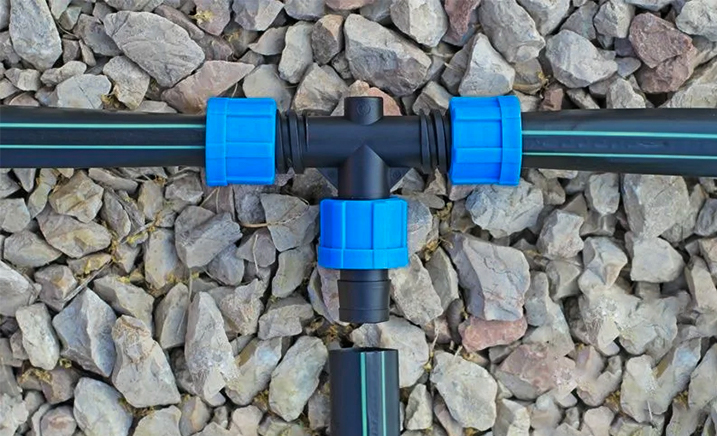
For permanent installations subject to freezing risk or chemical exposure, butt fusion and electrofusion joints are strongly preferred. Both create a fully homogeneous bond between pipe and fitting material, eliminating the interface gap where stress concentrates and where freezing water can exploit small voids. Compression fittings, while convenient, are not recommended for buried cold-climate service due to the risk of grip-ring relaxation under cyclic thermal loading.
Analysis of PE Pipe Leakage Causes: Where Failures Actually Occur
An analysis of PE pipe leakage causes across water supply and industrial piping systems consistently points to the same cluster of failure origins. Understanding these patterns allows maintenance teams to target inspection and preventive maintenance where it matters most.
Figure 2: Distribution of PE pipe leakage causes by category (% of reported field failures across water and gas distribution systems).
The dominance of fusion joint failures — accounting for approximately 34% of all reported PE pipe leaks — underscores the critical importance of proper PE pipe connection methods and operator training. Common joint failure modes include under-heating during butt fusion (cold fusion), contamination of fusion surfaces, misaligned electrofusion fittings, and inadequate cooling time before the joint is pressurized.
Third-party damage (excavation strikes, overloading of shallow buried pipe) accounts for 22% of failures and is best mitigated by adequate burial depth, warning tape installed 300 mm above the pipe, and accurate as-built records. The combined 28% share attributable to UV/thermal aging and freeze-thaw fatigue confirms that environmental protection — the focus of this article — is the single most actionable area for reducing long-term leakage risk.
Comparison of PE Pipes and PVC Pipes in Freeze and Aging Resistance
A comparison of PE pipes and PVC pipes is relevant here because both are widely used in similar applications, yet their behavior under freezing conditions and long-term aging differs substantially. This distinction often guides material selection for cold-climate and outdoor installations.
| Property | PE Pipe (HDPE/PE100) | PVC Pipe (uPVC) |
|---|---|---|
| Freeze resistance | Good — flexible, absorbs expansion | Poor — brittle at low temp, cracks under ice pressure |
| Min. service temperature | -40°C (retains flexibility) | +5°C (becomes brittle below 0°C) |
| UV aging resistance | Excellent (with 2% carbon black) | Moderate — discolors and embrittles without additive |
| Design service life | 50+ years | 25 – 50 years |
| Impact resistance at 0°C | High | Low |
| Max. continuous temp. | 60°C (PE100 at reduced pressure) | 60°C (uPVC, pressure-dependent) |
| Cold-climate suitability | Highly recommended | Not recommended for exposed cold service |
The most critical distinction in this comparison is low-temperature behavior. PVC becomes significantly more brittle below 5°C, and a sharp impact or moderate freeze event is sufficient to shatter uPVC pipe cleanly. PE retains meaningful flexibility and impact resistance down to -40°C, which is why it is the material of choice for cold-climate water supply and gas distribution networks worldwide.