English
 中文简体
中文简体 русский
 عربى
عربى
Most PVC elbow failures on site are not manufacturing defects. They are specification mismatches: a Schedule 40 elbow solvent-welded into a Schedule 80 line, a 45-degree fitting substituted where a long-radius sweep was designed, or a socket depth taken from one dimension standard and glued to pipe made to another. The joint passes a visual check and then fails at commissioning.
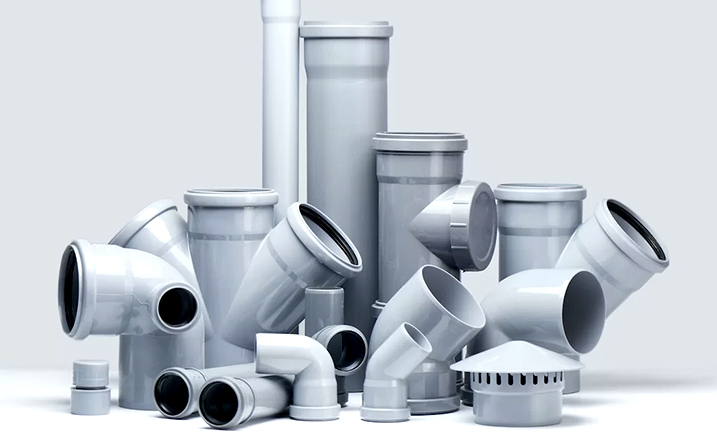
So here is the conclusion first. PVC elbows are classified by three properties at the same time: bend angle (90, 45, 22.5 and 11.25 degrees), connection method (solvent-weld socket, threaded, flanged, gasketed or spigot), and pressure class or schedule. The angle defines what the fitting does. The schedule and the dimension standard define whether the joint survives pressure testing. Buying on angle alone is where most mid-size projects lose money.
Content
- 1 PVC elbow types at a glance
- 2 How a PVC elbow is built: socket, wall thickness and bend radius
- 3 The 90-degree elbow: the default that causes the most trouble
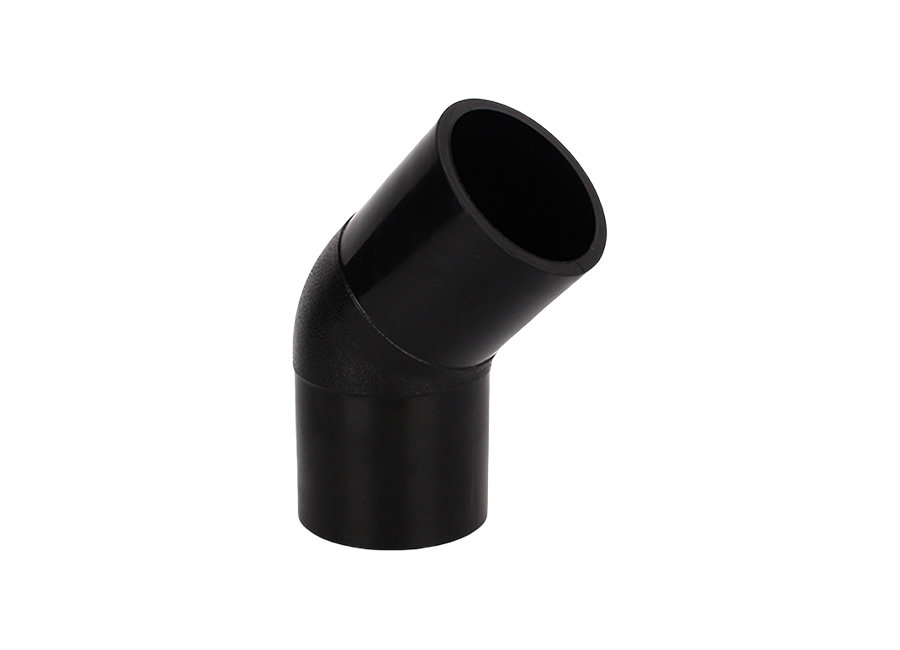
- 4 The 45-degree elbow: lower loss, longer route
- 5 Street elbows, reducing elbows and small-angle elbows
- 6 Material and joint variants: uPVC, PVC-M, PVC-O and PVDF
- 7 How to specify a PVC elbow correctly
- 8 Procurement mistakes that cost the most
- 9 FAQ: PVC elbow types and selection
PVC elbow types at a glance
Before matching a part number, match three things: what the elbow does, how it joins, and what pressure class it holds. The table below covers the fittings that appear in almost every PVC water, drainage and industrial line.
| Elbow type | Angle | Where it is used | Common standard reference | Verify before ordering |
|---|---|---|---|---|
| Short-radius 90° | 90° | Compact plant rooms, risers, drainage stacks, tight routing | ASTM D2466 (Sch 40), ASTM D2467 (Sch 80) | Schedule, socket depth, wall thickness |
| Long-radius 90° / sweep | 90° | Gravity drainage, solids and slurry lines, low-loss headers | ASTM D2665 / D3311 for DWV patterns | Bend radius against available space, lay length |
| 45° elbow | 45° | Long runs, gradual offsets, manifolds, lower pressure loss | ASTM D2466, ASTM D2467, ISO 1452 | Angle tolerance, socket concentricity |
| Street elbow | 90° / 45° | Fitting-to-fitting transitions where a socket would add length | Manufacturer drawings | Spigot length and taper, solvent trap risk |
| Reducing elbow | 90° / 45° | Branch take-offs where the line changes size at the turn | Manufacturer drawings | Both end sizes, velocity rise at the reduced bore |
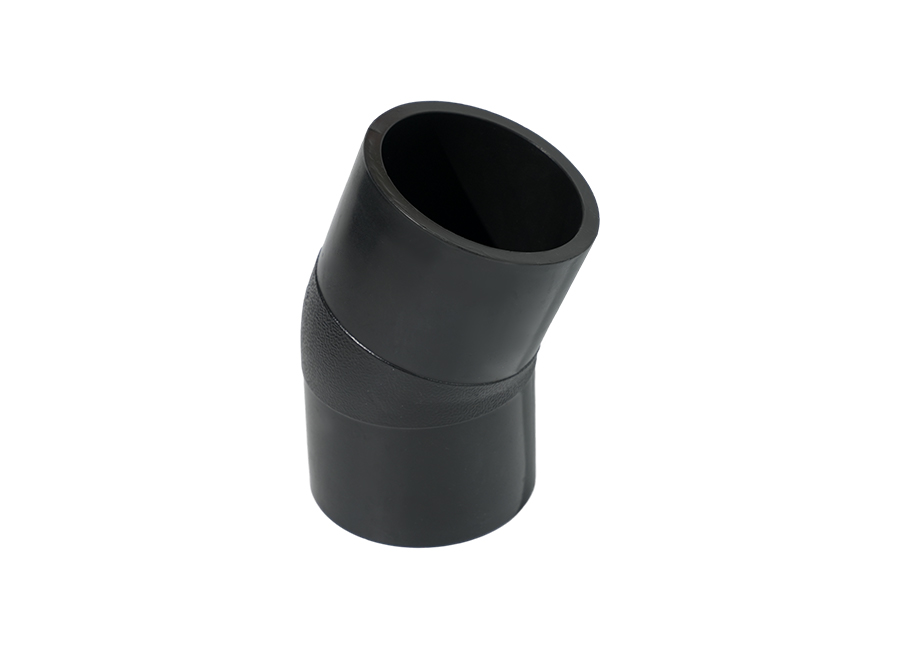
| 22.5° / 11.25° elbow | Small angle | Pipeline alignment and minor offsets over long distances | Project specification | Availability and lead time, rarely a stock item |
How a PVC elbow is built: socket, wall thickness and bend radius
A PVC elbow is defined by four dimensions that rarely appear on the carton: outside diameter, socket depth, wall thickness, and centerline bend radius. Two fittings sold as "110 mm, 90°" can differ by several millimetres in socket depth, and that difference is the gap between a joint that holds 16 bar and one that weeps at 6 bar.
Socket depth matters because solvent-weld strength depends on bonded surface area. Dry-fit the pipe into the socket before applying cement. On a correctly matched pair, the pipe should bottom out with roughly 1 to 2 mm of insertion remaining, and a light quarter turn should meet even resistance the whole way. A pipe that seats with a wobble means the socket is oversized or the pipe is out of round. On gasketed joints, the same dry fit confirms that the spigot reaches past the gasket lip rather than stopping short.
The 90-degree elbow: the default that causes the most trouble
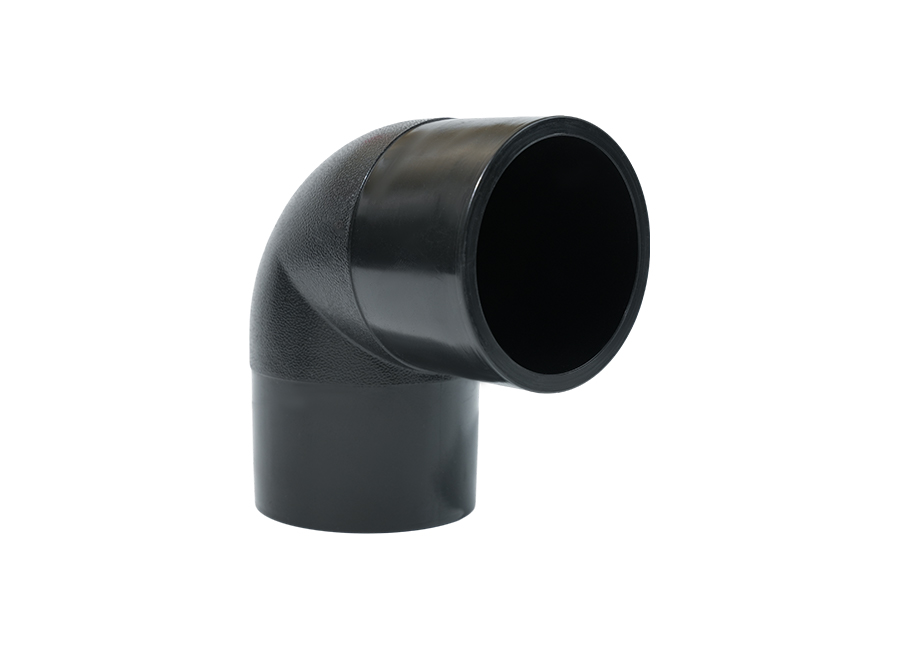
Roughly nine out of ten direction changes in a PVC line use a 90-degree elbow, and it is also where most hydraulic and mechanical problems begin. Two fittings carry the same "90°" label but behave differently. A short-radius elbow turns the flow within about one and a half pipe diameters; a long-radius or sweep elbow takes roughly three. The long-radius version costs more and occupies more space, but it reduces local pressure loss and cuts erosion on the outer wall where solids strike the bend.
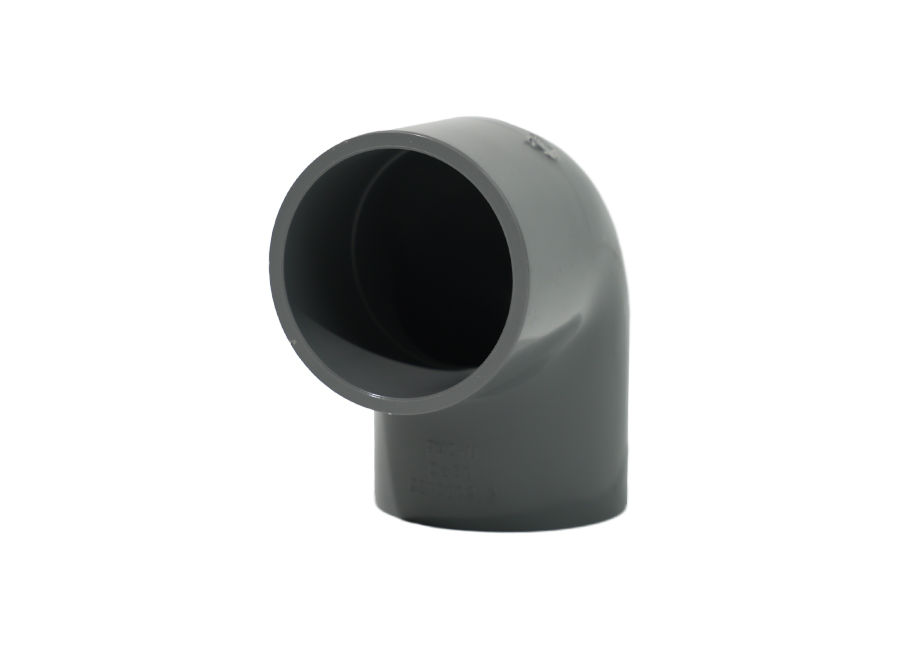 PVC-U 90 Degree Elbow Fittings for Pipeline SystemsPVC-U 90-degree elbows rated 1.0/1.6 MPa with solvent-cement or flange connections, sized 20-400 mm; useful where 90° bends affect pressure loss and erosion.View Product →
On pressure lines, every 90° elbow is a local restriction. Stacked elbows compound the effect: two 90° bends on the same header can consume more head than the entire straight run between them. If a pump is already running near the end of its curve, replacing one 90° elbow with two 45° elbows, or with a long-radius 90°, is often the cheapest correction available. The calculation method is set out in this note on pressure loss from multiple 90-degree elbows.
The 45-degree elbow: lower loss, longer route
The 45° elbow exists for one reason: it turns the flow with less disturbance than a 90° fitting. Two 45° elbows separated by a short spool piece produce a gentler change of direction than a single 90°, and on long pumping mains the saved head can pay back the extra material within the first year of operation. The trade-off is space and cost. Two fittings, an extra joint and a longer lay length usually add 30 to 50 percent to that section of the bill of materials compared with one 90° elbow.
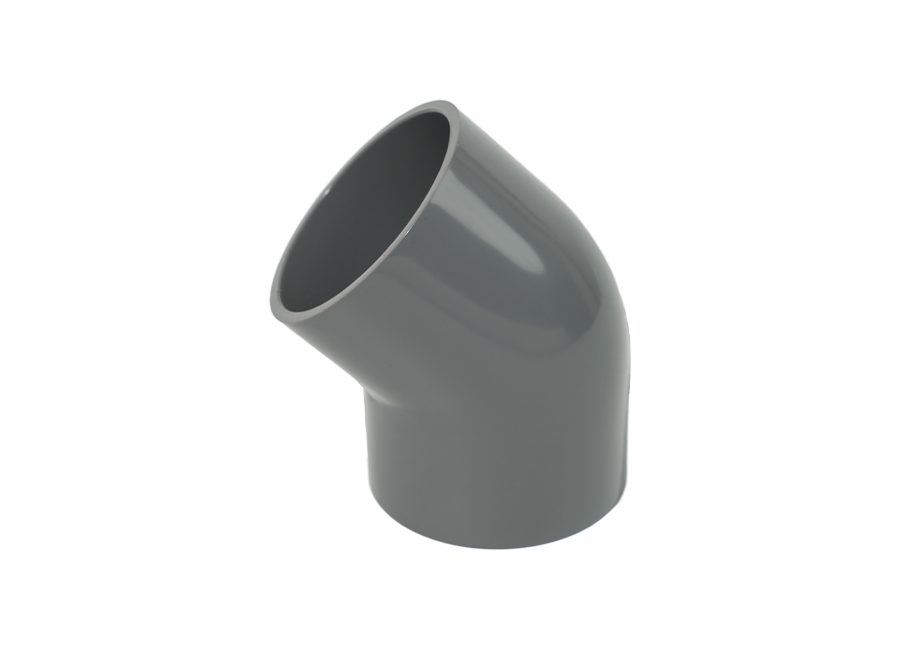 PVC-U 45 Degree Elbows for Water Supply and DrainagePVC-U 45-degree elbows in 20-400 mm sizes, rated 1.0/1.6 MPa, with solvent-cement, socket, or flange connections; suited to drainage flow and gentler direction changes.View Product →
In gravity drainage the opposite logic applies. A 45° elbow on a soil stack keeps solids moving and reduces the chance of blockage at the bend, which is why many plumbing codes restrict the use of short-radius 90° fittings on horizontal-to-vertical transitions in drainage systems. When a designer specifies a 45° elbow there, it is a functional requirement, not a cost decision.
Street elbows, reducing elbows and small-angle elbows
Three less common variants solve specific layout problems and are frequently ordered by mistake.
Street elbow (spigot x socket)
One end is a plain spigot instead of a socket, so the fitting plugs directly into another fitting's socket. This saves 20 to 40 mm of length in tight risers and plant rooms. The risk is solvent entrapment: if too much cement is applied, excess solvent has nowhere to escape and softens the joint from the inside. Use a thinner cement coat and hold the joint still for the full cure time.
Reducing elbow
A single fitting changes both direction and size. It saves a separate reducer and a joint, but it concentrates the flow at the reduced bore. Check the velocity at the small end against the pipe manufacturer's recommended limit; on a 110 mm to 63 mm reduction at 2 m/s inlet velocity, the outlet velocity roughly triples, which raises noise, erosion and water hammer risk.
22.5° and 11.25° elbows
These are alignment fittings for long pipelines where a fraction of a degree of offset accumulates over hundreds of metres. They are almost never stock items, so lead time rather than price is the deciding factor. Confirm availability before finalising the pipe route on the drawing.
Material and joint variants: uPVC, PVC-M, PVC-O and PVDF
The bend angle is only half the specification. The material grade determines pressure rating, impact resistance and temperature limit, and the joint type determines how the fitting behaves under movement and vibration.
- uPVC (PVC-U): the standard solvent-weld system for cold water, drainage and irrigation. High stiffness, low cost, but brittle below about 5 °C and unsuitable for continuous hot water service.
- PVC-M: modified with impact modifiers, giving noticeably better resistance to cracking during handling and trench backfill at similar pressure ratings.
- PVC-O: molecularly oriented, so the wall can be thinner for the same pressure class. Lighter, tougher, and increasingly used in water mains.
- PVDF: a fluoropolymer fitting for chemical dosing, high-purity and higher-temperature industrial lines where uPVC would soften or be attacked by the medium.
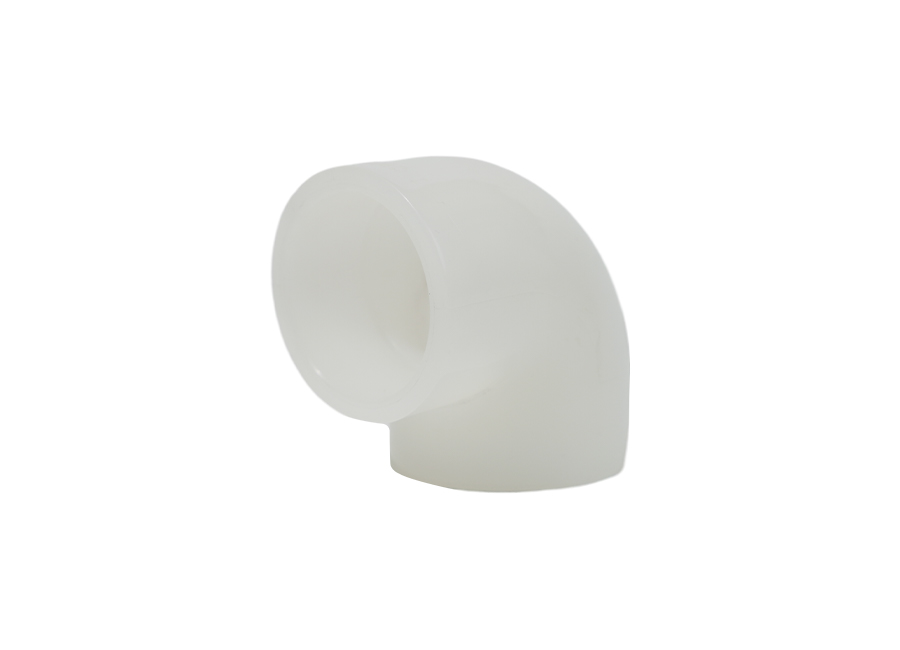 PVDF 90 Degree Elbow for Chemical and High-Temperature PipingPVDF 90-degree elbows rated 0.6/1.0 MPa for corrosive or high-temperature service, with socket and butt-welding options from 32-630 mm.View Product →
Joint type matters just as much. Solvent-weld sockets are rigid and permanent; threaded joints are serviceable but rely on thread sealant and are more prone to stress cracking at the thread root; flanged and gasketed joints allow dismantling and absorb small movements. A manufacturer that moulds fittings and extrudes pipe in the same plant can normally guarantee that socket dimensions and wall thickness match per size, which is worth asking about directly. The uPVC and PVDF piping range from Huada Plastics, for example, is published with socket dimensions listed per nominal size.
How to specify a PVC elbow correctly
- State the dimension standard, not just the size: for example ASTM D2466 for Schedule 40 socket fittings or ISO 1452 for PVC-U water supply fittings.
- State the schedule or pressure class: Schedule 40, Schedule 80, PN10 or PN16 are not interchangeable even when the outside diameter matches.
- State the material grade: uPVC, PVC-M, PVC-O, CPVC or PVDF, with the intended service medium.
- State the joint type: solvent-weld socket, threaded, flanged, gasketed or spigot, and specify the socket depth if the line already exists.
- State the service temperature and apply the derating factor. Published PVC derating tables reduce allowable working pressure to roughly half the 23 °C rating by around 43 °C, and continue falling above that.
- State the bend radius: short radius or long radius, and confirm the available space in the pipe route.
Angle, schedule, standard, material, joint. If a quotation lists only "90° elbow, 110 mm", it is incomplete — and the missing field is usually the one that fails.
Procurement mistakes that cost the most
- Mixing dimension standards. A fitting made to one standard and pipe made to another can share the same nominal diameter but differ in socket depth and wall thickness.
- Assuming Schedule 40 and Schedule 80 are interchangeable. Outside diameters match; wall thickness and pressure rating do not.
- Ignoring UV exposure. Unpainted PVC in direct sunlight degrades over years of outdoor service; pigmented compounds or UV-resistant grades are the practical answer.
- Using uPVC elbows on hot water or chemical lines. Above roughly 60 °C, uPVC loses strength quickly and CPVC or PVDF becomes the correct choice.
- Buying on price per piece only. A cheaper elbow with a shallower socket can double the leak risk on a pressurised line, and rework costs far more than the fitting.
- Ordering small-angle elbows late. Non-stock items extend the schedule, and a pipeline alignment that depends on them cannot be closed out early.