English
 中文简体
中文简体 русский
 عربى
عربى
A 160 mm HDPE pipe sounds like a complete specification — until two suppliers quote the same nominal diameter with very different wall thicknesses. One offers SDR 11 with a 14.6 mm wall; the other SDR 17 with a 9.5 mm wall. Both are "DN160 HDPE pipes." Yet the first is rated for 16 bar working pressure, while the second is limited to 10 bar. That single difference changes the cost of the pipeline, its flow capacity, and the risk profile of the entire installation. Understanding HDPE pipe dimensions is not about reading a ruler. It is about knowing how outside diameter, wall thickness, and SDR class work together to define what a pipe can actually do.
Content
- 1 HDPE Pipe Dimensions: OD, ID, and Wall Thickness
- 2 Standard HDPE Pipe Sizes and SDR Classes
- 3 SDR: The Ratio Behind HDPE Pipe Pressure Ratings
- 4 How to Choose the Right HDPE Pipe Dimension
- 5 Common Mistakes When Reading HDPE Pipe Dimensions
- 6 Frequently Asked Questions
- 6.1 Q1: What does SDR mean in HDPE pipe dimensions?
- 6.2 Q2: Is HDPE pipe size measured by OD or ID?
- 6.3 Q3: What is the difference between SDR 11 and SDR 17?
- 6.4 Q4: What pressure rating does SDR 11 HDPE pipe have?
- 6.5 Q5: What is the maximum HDPE pipe diameter available?
- 6.6 Q6: What is the minimum bending radius for HDPE pipe?
HDPE Pipe Dimensions: OD, ID, and Wall Thickness
HDPE pipe is dimensioned by its nominal outside diameter (OD), following ISO 4427 and EN 12201. Polyethylene pipe is not sized by internal bore the way many steel pipe systems are. The inside diameter (ID) is always a derived value:
ID = OD - 2 × wall thickness
The wall thickness itself is expressed through the Standard Dimension Ratio:
SDR = OD / wall thickness
For any given OD, a thicker wall increases the pressure rating but shrinks the flow area. Because the wall is only part of the total outer diameter, the bore of an SDR 11 pipe is noticeably smaller than the bore of an SDR 17 pipe of the same outer dimension. Selecting a pipe dimension therefore means choosing a pair of values: the OD that fits the hydraulic design, and the SDR class that provides the required pressure capacity and stiffness.
Figure 1. Isometric view of an HDPE pipe end showing OD, ID, and wall thickness. The green ring is the solid pipe wall.
Standard HDPE Pipe Sizes and SDR Classes
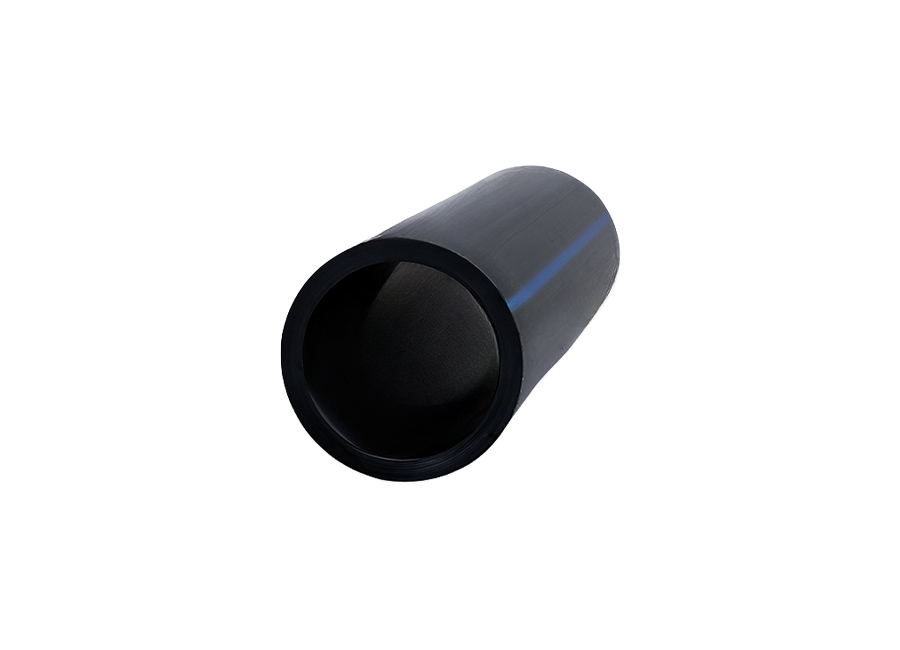 High-Density Polyethylene (HDPE) Pipe in PE100 with Multiple Pressure RatingsThis HDPE pipe is made from PE100 material and available in pressure grades from PN6 to PN16. It connects via hot melt welding and suits irrigation, house connections, and larger supply lines across a wide range of nominal sizes.View Product →
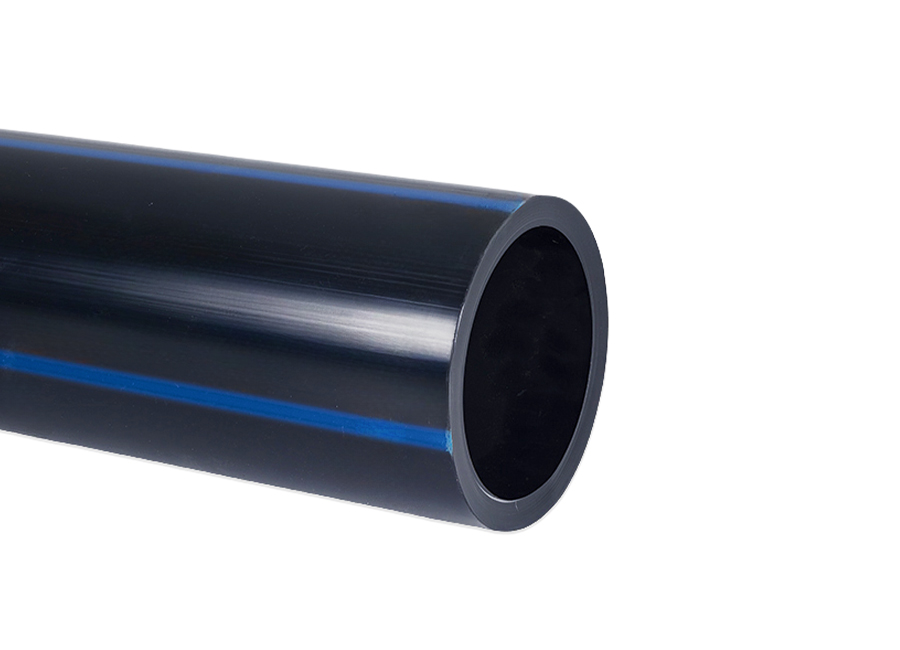
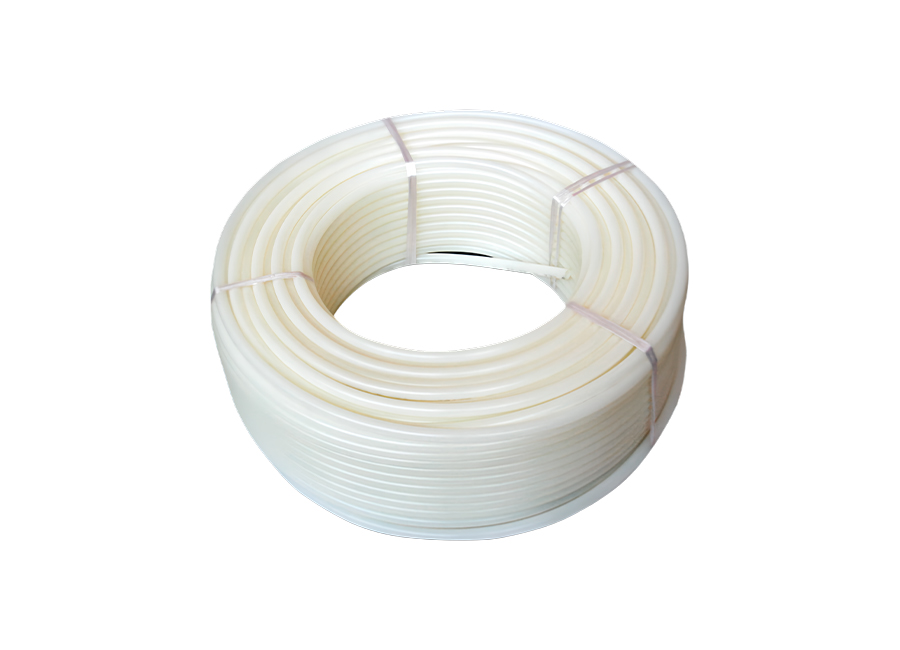
HDPE pipe is manufactured in nominal sizes from 20 mm to 1600 mm in diameter. Small pipes (20–32 mm) are commonly sold in coils for irrigation, drip lines, and house connections. Medium sizes (50–160 mm) are available in coils or straight bars, and larger diameters are supplied in 6 m, 12 m, or 15 m straight lengths. The table below lists common nominal sizes with the corresponding wall thicknesses for two widely used SDR classes.
| Nominal Size DN/OD (mm) | Outside Diameter OD (mm) | Wall Thickness SDR 11 (mm) | Wall Thickness SDR 17 (mm) |
|---|---|---|---|
| 20 | 20 | 2.0 | — |
| 25 | 25 | 2.3 | 1.5 |
| 32 | 32 | 2.9 | 1.9 |
| 40 | 40 | 3.7 | 2.4 |
| 50 | 50 | 4.6 | 3.0 |
| 63 | 63 | 5.8 | 3.7 |
| 75 | 75 | 6.8 | 4.5 |
| 90 | 90 | 8.2 | 5.4 |
| 110 | 110 | 10.0 | 6.6 |
| 160 | 160 | 14.6 | 9.5 |
| 200 | 200 | 18.2 | 11.9 |
| 315 | 315 | 28.6 | 18.7 |
The pattern is consistent: the larger the DN, the thicker the wall for the same SDR. A DN315 SDR 11 pipe has a 28.6 mm wall, comparable to the wall of steel pipe of similar rating, which explains the substantial weight savings when handling HDPE on site.
SDR: The Ratio Behind HDPE Pipe Pressure Ratings
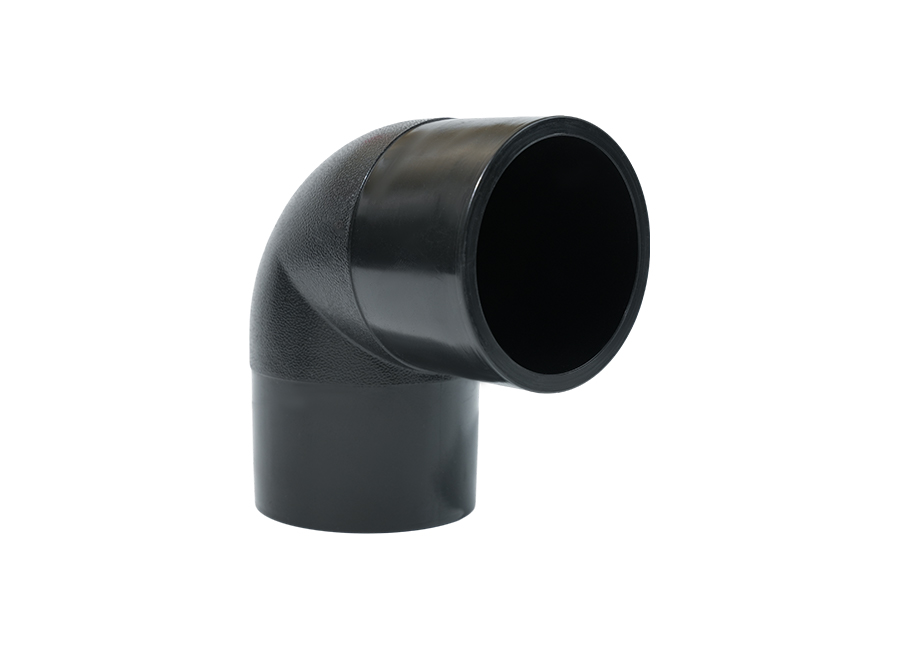
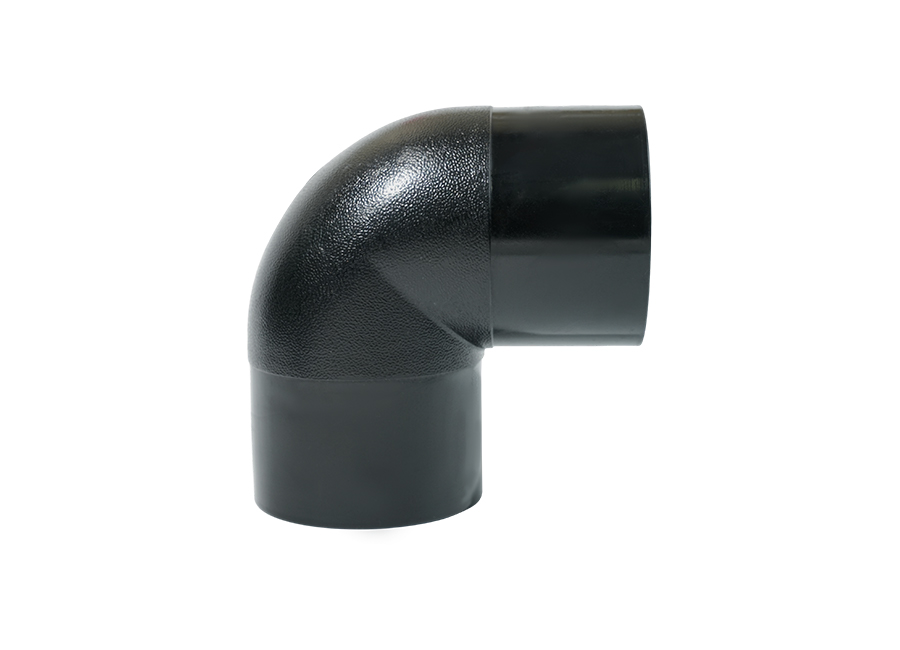 HDPE 90 Degree Elbow for PE100 Piping SystemsThis 90-degree elbow enables right-angle turns in HDPE pipelines, simplifying layouts and adapting to multi-directional transitions. Made from PE100, it offers creep resistance and electrical insulation for flexible, durable system design.View Product →
The SDR value does more than define geometry — it fixes the pressure rating. For PE100 material, the nominal pressure is calculated as:
PN = 20 × MRS / (C × (SDR - 1))
where MRS is the minimum required strength (10 MPa for PE100, 8 MPa for PE80) and C is the design coefficient, usually 1.25 for water applications. Applying this formula gives the nominal pressure classes shown in Figure 2.
Figure 2. Nominal pressure rating of PE100 HDPE pipe by SDR class, calculated at 20 °C with a design coefficient of 1.25.
SDR 11 is the most commonly specified class for pressure pipelines because it delivers a 16 bar rating — adequate for most municipal water distribution — with a reasonable material cost. SDR 17 (PN 10) is used for lower-pressure gravity mains and irrigation. Where surge pressures or high operating temperatures are expected, SDR 9 or SDR 7.4 provides the necessary safety margin. The same logic applies to fittings: a butt-fusion elbow or tee must carry the same SDR as the pipe so that the joint wall thickness matches.
How to Choose the Right HDPE Pipe Dimension
Diameter selection starts with hydraulic requirements, not with a pipe table. Once the design flow rate is fixed, the internal bore determines velocity and head loss, and that leads to a standard OD. The pressure class then sets the wall thickness. Figure 3 compares wall thickness at DN160 across common SDR classes — a useful reference when evaluating whether a thinner, cheaper SDR 17 wall can meet the pressure demand.
Figure 3. Wall thickness of a DN160 HDPE pipe across SDR classes. Lower SDR means thicker wall, higher pressure rating, and smaller internal bore.
A practical selection workflow:
- Calculate the required flow area. Use a hydraulic formula (Darcy–Weisbach or Hazen–Williams) together with the design flow rate and an acceptable velocity — typically 0.5 to 2.0 m/s in water systems — then choose the smallest standard OD that fits.
- Convert the operating pressure to a PN class. Include surge pressure in the calculation. Select an SDR class that covers the maximum head, including water hammer.
- Account for external loads. Deep burial, traffic loading, and soil settlement may require a lower SDR (thicker wall) than pressure alone would dictate.
- Check fitting and valve compatibility. All components must match the pipe OD and SDR; electrofusion and butt-fusion joints depend on identical wall geometry. Our step-by-step PE pipe purchase guide walks through this process from quotation to delivery.
Common Mistakes When Reading HDPE Pipe Dimensions
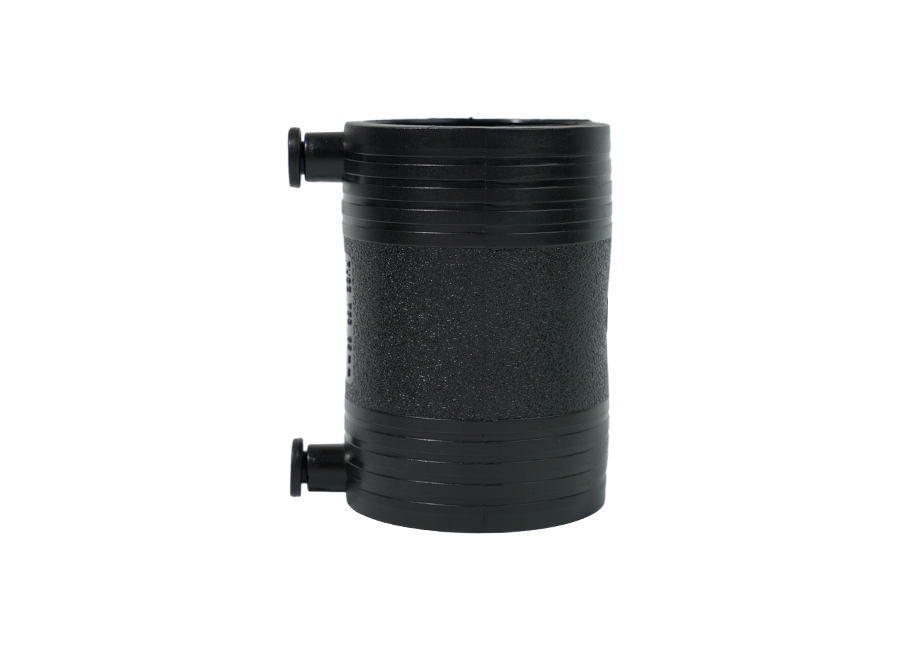 HDPE Electrofusion Coupling with PE100 and Copper ConstructionThis electrofusion coupling combines PE100 and copper for robust joints with strong sealing and corrosion resistance. It works in acidic, alkaline, or saline environments and simplifies installation while ensuring reliable, leak-free connections.View Product →
Procurement errors usually show up on the construction site, not in the office. These are the dimension-related mistakes we most often see:
- Specifying only the nominal diameter. "160 mm pipe" does not define pressure capacity. Always state the SDR or wall thickness and the material grade, for example "DN160 PE100 SDR11."
- Assuming the internal bore matches the nominal size. Because HDPE is sized by OD, a DN160 SDR11 pipe has an ID of about 130.8 mm, while a DN160 SDR17 pipe has an ID of about 141 mm. Equipment selected on the larger bore can under-perform when installed on a thicker-walled pipe.
- Mixing SDR classes in the same pipeline. A butt-fusion joint between SDR 11 and SDR 17 pipe is not code-compliant because the wall thickness mismatch prevents a proper fusion bead. Electrofusion couplings have the same requirement.
- Ignoring the effect of temperature on pressure rating. Catalogue PN values are valid at 20 °C. At 40 °C, per common PE pipe design guidance, the allowable pressure for PE100 is about 25 percent lower, which effectively forces a lower SDR selection.
- Forgetting that wall thickness has tolerances. ISO 4427 defines negative tolerances from nominal wall thickness, so the actual ID can be slightly larger than calculated. This affects both flow area and hoop stress.
When dimension matching is critical — especially for electrofusion joints and flanged connections — verify fitting availability against the chosen pipe dimensions before finalizing the schedule. Our product catalogue is a useful place to start.
Frequently Asked Questions
Q1: What does SDR mean in HDPE pipe dimensions?
SDR, or Standard Dimension Ratio, is the outside diameter divided by the wall thickness. It is the number that defines the pressure rating of the pipe. A lower SDR means a thicker wall; SDR 11 is thicker and stronger than SDR 17.
Q2: Is HDPE pipe size measured by OD or ID?
HDPE pipe is specified by its outside diameter, per ISO 4427 and EN 12201. The internal bore is a calculated value: OD minus twice the wall thickness. Always confirm both OD and SDR, not just the nominal size.
Q3: What is the difference between SDR 11 and SDR 17?
SDR 11 has a thicker wall and a higher pressure rating than SDR 17 for the same diameter. For PE100, SDR 11 is rated PN 16 bar while SDR 17 is PN 10 bar. SDR 11 also costs more per metre and has a smaller internal bore.
Q4: What pressure rating does SDR 11 HDPE pipe have?
For PE100 grade, SDR 11 has a nominal pressure rating of 16 bar at 20 °C with a design coefficient of 1.25. For PE80, the same SDR 11 corresponds to about PN 12.5 bar. Confirm which grade your supplier is quoting.
Q5: What is the maximum HDPE pipe diameter available?
Large-diameter HDPE pipe is available up to 1600 mm outside diameter for major infrastructure projects. Above DN1200, transport restrictions usually limit straight pipe length, and coils remain practical only for smaller diameters.
Q6: What is the minimum bending radius for HDPE pipe?
For SDR 11, the minimum bending radius is typically 20 times the OD; for SDR 17, it is about 25 times the OD at 20 °C. In cold weather, use a larger radius because HDPE becomes stiffer and more brittle at lower temperatures.